Simple science activities for kids are the fastest way into a preschooler’s curiosity. Not flashcards. Not worksheets. A cup of water and a handful of objects from your kitchen. That is where it starts. At Tappy Toes Nursery, we have seen two-year-olds spend forty minutes pouring, watching, and trying again. No prompting needed. Just the right setup.
Why Science Activities in School Matter Before Age Five
Most parents think science belongs to older kids. Lab coats, secondary school, Bunsen burners. That picture is wrong. The two-to-six window is when a child’s brain builds its thinking habits. Fast. What gets practised here tends to stay. Children who observe, predict, and question early develop stronger problem-solving instincts. New ideas meet less resistance later on.
This is not about facts. It is about the habit of wondering why. Why does the leaf float? Why does the ice shrink? A child who learns to sit with a question builds something far more useful than content knowledge. Waiting for the answer is not the same skill. Sounds too simple? It is. And that is exactly the point.
At Tappy Toes Nursery, our British Curriculum and EYFS framework treat this as a core principle. Science is not a timetable slot. It runs through our preschool activities and Continuous Provision Areas every day. Discovery happens alongside play, not separate from it.
What Children Actually Learn From Hands-On Experiments
Watch a child drop a grape into water. Before it goes in, ask what will happen. They pause. They think. They guess. That is hypothesis formation at age three. Every hands-on experiment builds a specific skill. Not vaguely. Specifically.
Science activities for kids at the preschool stage develop real skills. Here is what happens:
- Observation: Using all five senses to notice the world, not just look at it.
- Prediction: Forming an idea before the experiment. That is early reasoning.
- Comparison: What is the same? What is different? That is analytical thinking starting young.
- Communication: Putting what they saw into words. Language and science grow together.
- Focus and patience: Staying with a task until something changes. Every subject needs this.
Pouring, scooping, and stirring also build fine motor strength. The grip it takes to pour water accurately is the same grip used to hold a pencil later. This is why sensory play sits right next to science in early years development. They feed the same growth.
Easy Experiments to Try at Home
You do not need a science kit. Everything on this list comes from your kitchen or bathroom. Any Carrefour or Lulu has it. No specialist shops, no ordering online, no preparation beyond five minutes.
Colour Mixing With Water: Fill three cups. Water in each. Red colouring in one, blue in another, nothing in the third. Before your child pours two together, stop them. Ask what they think will happen. Make them commit to a guess. Then let them pour. Most children want to do this six or seven times with different combinations. Good. That repetition is exactly what learning looks like at this age.
Sink or Float: Bowl of water. Ten small objects: a coin, a grape, a cork, a spoon, a stone. Collect them in two minutes from any room in the house. One by one, your child predicts. One by one, you test. The results sometimes surprise even adults. That surprise is the moment. Children want to keep adding objects. Let them. They are running their own experiment now.
Growing a Seed: Large bean seed. Clear zip-lock bag. Damp cotton wool inside. Stick it to a sunny window. Check it every morning. Within a few days a root appears. This one takes patience, which is why it works. The child has to come back tomorrow. And the day after. Watching something grow because you put it there is a specific pride. Most four-year-olds have never felt it before. This one also works brilliantly on a Dubai windowsill in winter.
Baking Soda and Vinegar: Small spoon of baking soda in a cup. A little vinegar poured in. Stand back. The fizz is dramatic and completely safe. Older preschoolers start to understand that two things combined to make something new. That is a chemical reaction. At age four. Explained by a cup and a spoon. No kit. No instructions. Just two things that did something unexpected when they met.
How We Run Science Activities in School at Tappy Toes Nursery
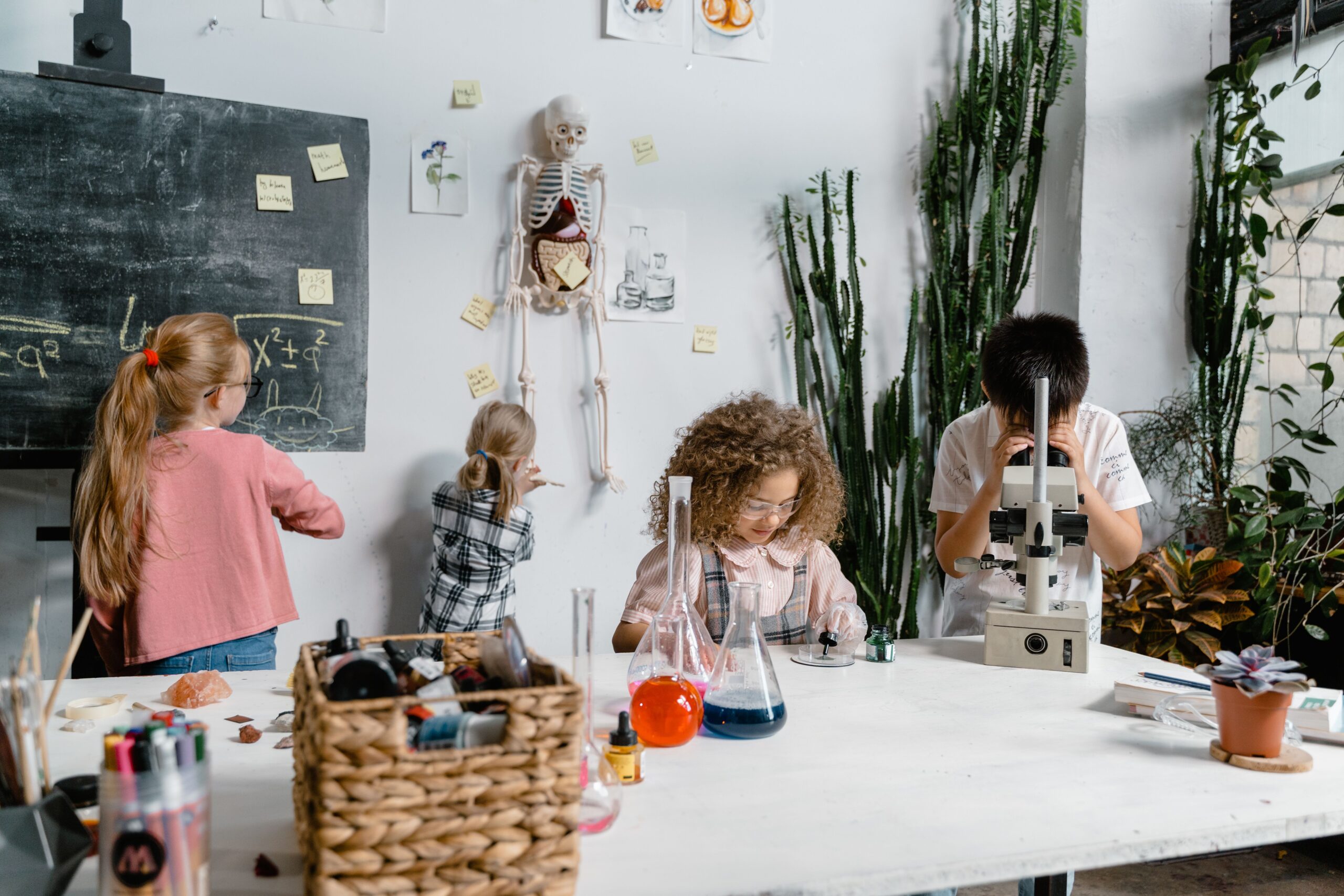
Science activities in school at Tappy Toes Nursery are not a once-a-week event. They are part of our curriculum. Our Continuous Provision Areas let children return to experiments at their own pace. Their own terms. A child who explored colour mixing on Monday may come back on Wednesday with a different idea. That revisiting is the real learning. Not the first attempt. Our teachers are KHDA-approved and trained to guide discovery rather than direct it. There is a real difference. “What do you think will happen?” is not the same as “Watch what happens.” One builds a thinker. The other just shows them something. Our STEM programme for preschoolers runs science, technology, engineering, and maths as one thread. Not four separate slots.
When a child makes a prediction and watches it play out, they learn their thinking has weight. That lesson is hard to undo. And it costs nothing to start.
Start Before Primary School
Waiting until primary school to introduce science is the wrong call. By then the most open window for building questioning habits has already narrowed. Preschool is the right time. Not because children need to learn facts early. Because they are wired to ask why. They just need a reason to do it. Science activities for kids at this age need three things. Curiosity. Patience with wrong answers. Five minutes of your attention. That is the whole list. No lab required. No science degree either. Just a willing child and a spare five minutes.
Want to see how we bring science activities in school to life every day? We would love to show you. Book a visit to your nearest Tappy Toes Nursery campus: Dubai South, Al Karama, Sharjah, or Fujairah.